|
Learn the secrets to bench press form that will
send your strength
and muscle development
through the roof!
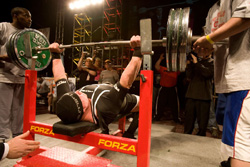 The Flat Barbell Bench Press is one of the most popular
exercises in the gym, yet how many people know the most
important techniques for maximizing strength and power
during each rep?
The Flat Barbell Bench Press is one of the most popular
exercises in the gym, yet how many people know the most
important techniques for maximizing strength and power
during each rep?
In this article, you will find solid tips without the fluff.
These tips will instantly help you to improve your bench
press RIGHT NOW! You don't need any special equipment to
use these techniques, just a willingness to learn.
Several of these tips will be further demonstrated with
pictures (there will be a link to this picture page at the
end of the article).
1. The perfect bench press rep starts without any weight on
the bar. Why no weight? The first thing you need to do is
determine your proper hand spacing on the bar.
Lie down on the bench and unrack the bar as you normally
would. Lower the bar to your chest and have a partner take
note of the orientation of your forearms. For optimal
power, your forearms should be as close to vertical at the
bottom of the rep as possible. Adjust your grip accordingly
and take note of where your hands are in relation to the
smooth rings on the Olympic bar.
The reason for this is simple: if your hands are placed
wider, some of your pushing power will be expended pushing
outwards rather than upwards. If your hands are placed
closer, power is expended pushing inwards. When your
forearms are vertical, the vast majority of your power
goes to pushing the bar directly up.
2. Now that you have your grip properly positioned, put
some weight on the bar. Lay back on the bench and plant
your feet firmly on the floor. Your knees should bent at
about an 80 degree angle (I will explain the reason for
this later - this tip has an accompanying picture). DO NOT
place your feet up on the bench. You will lose stability
and potential power by doing this.
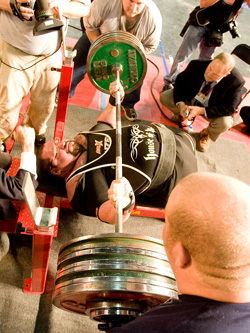 Place your hands on the bar in the grip width that you
determined previously.
Place your hands on the bar in the grip width that you
determined previously.
A technique that I like to use to lock my shoulders into
the position for maximum strength and stability is as
follows:
-Instead of placing your palms on the bottom of the bar,
place them on the back of the bar (this tip also has an
accompanying picture).
-Now, without removing your grip, rotate the bar down so
that your palms are now directly under the bar. This has
the effect of placing your shoulders into their most
stable and strong position. It will almost feel as though
you are "locking down" your shoulders.
-As you are rotating the bar and locking down your
shoulders, lift your torso slightly off the bench and
force your shoulder blades together tightly underneath
your torso.
-This will force your shoulders back and puff your chest
out, placing the pectorals in a position where they have
a more effective line of pull. It also has the added bonus
of making your torso thicker, reducing the distance you
need to press the weight.
-Keep your shoulder blades squeezed tightly behind you for
the duration of the set.
3. Remove the bar from the racks and tighten up the muscles
of your torso. Begin lowering the bar under complete control
to a point at the bottom of your sternum (about even with
the bottom of your sternum, a.k.a. the breastbone). Imagine
as though your muscles are springs storing up all the energy
of the weight lowering and getting ready to explode it all
back out. Inhale as you lower the bar and feel it
tightening up your chest.
Lightly touch the weight to your chest. DO NOT bounce the
weight off your chest! This can cause injury in the form of
cracked ribs or even snapping the tip of the sternum (a
little bony protrusion known as the Xiphoid Process). It
also diffuses the tension you've built up in the
pectorals, reducing the effectiveness of the exercise for
building strength and muscle mass.
4. As you start to change the direction of the bar and
begin the press up, drive with the legs. This is a
technique that most trainers do not know about. It's strange
to think about it but your leg power can actually help you
bench press more weight!
This technique should be practiced with an empty bar before
attempting it during a regular set. Start by planting your
feet flat on the floor with your knees bent about
80 degrees. This angle is very important as it is what
allows you to push with your legs.
-Lower the empty bar to your chest. The moment you start
to push the bar back up, push hard with your legs as
though you are trying to slide your body up the bench.
-With an empty bar you probably will be able to slide
yourself up the bench. When you have a loaded bar, however,
the weight will keep you from sliding and the pushing power
from your legs will get transferred through your body and
into pushing the bar up.
This is what's known as driving with your legs. It can really
beef up your power out of the bottom of the rep.
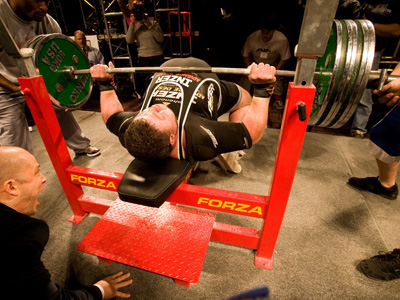
5. Exhale forcefully through pursed lips as you continue to
push the weight up. This will help maintain your torso
stability better than simply exhaling all at once.
-Keep your feet firmly planted on the floor even if you
start to struggle with the weight. The moment you lift
your feet off the floor, you break your base of power and
the odds of you completing the lift diminish greatly.
-If you have a tendency to shift your feet around, try
placing 2.5 pound plates on your feet. This is not to weigh
your feet down but to help you be more aware of what is
happening with your feet. If a plate falls, your foot has
moved. Strive to keep those plates in place.
-The bar should follow a slight backwards arc as you press
it up, moving from your lower rib cage to over your face at
the end of the rep.
-Be aware of your sticking point and try to drive the bar
through it rather than letting the bar slow down as you
come up to it. There are many training methods for working
on sticking points that I will delve into in a future
article.
6. Power the weight up to lockout. You have just completed
the perfect rep! Now do it again!!
Using these techniques can add immediate poundage to your
bench press. Your chest will thank you for it!

Return To Weight Lifting Articles Archive
|